All posts filed under: Feast day

“The Person of Love in the Life of God”

We have compiled some quotations for pertaining to Pentecost and the Holy Spirit, from the Church Fathers and others. St. Iranaeus: “He had promised through the prophets that in these last days he would pour out his Spirit on his servants and handmaids, and that they would prophesy. So when the Son of God became the Son of Man, the Spirit also descended upon him, becoming accustomed in this way to dwelling with the human race, to living in men and to inhabiting God’s creation. The Spirit accomplished the Father’s will in men who had grown old in sin, and gave them new life in Christ.” St. Ambrose of Milan: “So, then, the Holy Spirit is the River, and the abundant River, which according to the Hebrews flowed from Jesus in the lands, as we have received it prophesied by the mouth of Isaiah. This is the great River which flows always and never fails. And not only a river, but also one of copious stream and overflowing greatness, as also David said: “The stream of …

Simple Pentecost Traditions for the Home

Nevertheless, I tell you the truth: it is to your advantage that I go away, for if I do not go away, the Helper will not come to you. But if I go, I will send him to you. And when he comes, he will convict the world concerning sin and righteousness and judgment: concerning sin, because they do not believe in me; concerning righteousness, because I go to the Father, and you will see me no longer; concerning judgment, because the ruler of this world is judged. John 16:7-11 (ESV). As always, we would direct you to the extensive repository of information to be found at Full Homely Divinity. We thought we would also highlight a few ideas. Pentecost Litany Here is a printable of a Litany of the Holy Ghost, provided by our priest Fr. Wayne McNamara: Litany of Holy Ghost Barefoot on Pentecost: When researching this day, we learned that one Pentecost tradition is to go outside barefoot on Sunday morning and walk around in the dew. This originated from a verse in the …

Ascension Day: Christ Our King & Christ Our Brother

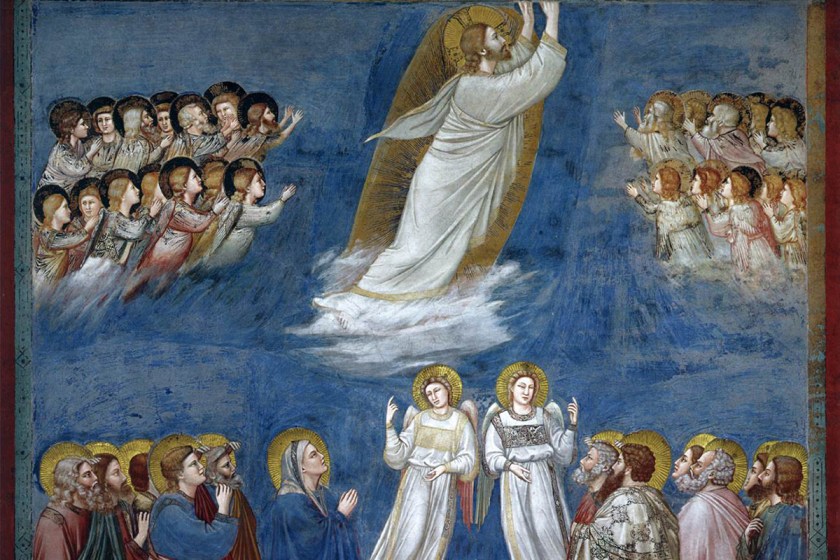
In the past, when I’ve thought about the Ascension, I’ve wondered, “What’s the big deal about Christ floating up into the clouds?”  I’ve felt that perhaps, the Ascension is slightly anti-climactic after the resurrection event. My imagination also has been stunted, since I can’t seem to picture the Ascension in any way that doesn’t seem ridiculous, whether flannel-graph-childish or Cape-Canaveral-Spaceship-launch. But this year, meditating on the Ascension has brought me great joy because this statement has been singing through my mind: The Ascension means that Christ is our King and is also our Brother. The Ascension is more than a miracle showing Jesus’ mastery over the physical world. It is Christ’s enthronement, when he is seated at the right hand of God as King and Priest. To be seated at God’s right hand is a frequent Biblical metaphor, especially noteworthy in Psalm 110, where a figure is foretold who unites the offices of King and Priest, with all things subjected under him.  Hence, right before his Ascension, Christ could declare “All authority in heaven and on earth has been given …

What are the Rogation Days?

This upcoming Sunday is Rogation Sunday, followed by the Rogation Days on Monday, Tuesday, and Wednesday. The lore of these days includes “beating of the boys” and a mysterious pastry called “Rammalation Biscuits,” so research was particularly interesting. What are the Rogation Days and how did they begin? From the always helpful Anglican resource Full Homely Divinity: The Rogation Days, the Monday, Tuesday, and Wednesday before Ascension Day, originated in Vienne, France (not Vienna, Austria), in 470 after a series of natural disasters had caused much suffering among the people. Archbishop Mamertus proclaimed a fast and ordered that special litanies and prayers be said as the population processed around their fields, asking God’s protection and blessing on the crops that were just beginning to sprout. The Latin word rogare means “to ask”, thus these were “rogation” processions. In an agricultural society, closely connected with the soil and highly vulnerable to the uncertainties of nature, this was an idea that took root quickly, and the custom spread around Europe and over to Britain. The Sunday before the Rogation …

“Darkness Flees at the Death of Death”

For Death is about to learn the final lesson: That Life and Death are after all not peers. They are not of the same kind; they are not cut from the same mold; they are not two sides of the same coin. Death is of the mortal creation. Death reigns as King over the mortal world. But death, by definition has no place in immortality. Infinity, which can hold all things, has no room for finitude.

“Now All Things Have Been Filled with Light”

Alleluia! Christ is risen! We have compiled some quotations from the church fathers, for your reflection and joy this Easter. St. John of Damascus: “Now all things have been filled with light, both heaven and earth and those beneath the earth; so let all creation sing Christ’s rising, by which it is established.” St. John Chrysostom: “O Death, where is your sting? O Hell, where is your victory? Christ is risen, and you are overthrown. Christ is risen, and the demons are fallen. Christ is risen, and the angels rejoice. Christ is risen, and life reigns. Christ is risen, and not one dead remains in the grave. For Christ, being risen from the dead, is become the first fruits of those who have fallen asleep.” St. Augustine: “Our Life himself came down into this world and took away our death. He slew it with his own abounding life, and with thunder in his voice he called us from this world to return to him in heaven. From heaven he came down to us, entering first the Virgin’s …

The Breastplate of St. Patrick

I look forward every year to St. Patrick’s Day and Trinity Sunday because of singing “The Lorica [or Breastplate] of St. Patrick.” It is a glorious expression of the cosmic realities of our Christian faith. Here is a beautiful arrangement by Melville Cook, sung by St. Peter’s Singers of Leeds: What is a Lorica? The original meaning of “Lorica” is armor or a breastplate. It developed, in the Christian monastic tradition, to mean a prayer of protection. These meanings merged in the reality that knights would often inscribe prayers upon their armor or pray these prayers before they went into battle. Are there other examples of loricas? Yes, there is the “Lorica of Gildas.” The Lorica, Rob tu mo bhoile, a Comdi cride, forms the basis for the hymn “Be Thou My Vision.” The Fursey Lorica is also particularly beautiful: The arms of God be around my shoulders The touch of the Holy Spirit upon my head, The sign of Christ’s cross upon my forehead, The sound of the Holy Spirit in my ears, The …

A Candlemas Celebration

“As we see in the gospel today, the Word, which spoke the world into existence, comes to the Temple. And how is he brought? Carried on a throne of gold? With all the nations gathered around to honor him? No, but in the throne of the Virgin’s arms. . . And what glory did await at the temple? Did Caesar himself stand up for the True King as he entered? Did the powerful people of all the nations come to honor him, and declare him the True Lord of Lords? No, he is greeted by a man who is only said to be a righteous and devout man. And by a woman, who is said to be a prophet, and who seems to have been a widow who spent her time in prayer in the temple.” “There were no kings and queens of the world greeting the Christ as he came to the Temple. What we see here, is a secret: that the kings and queens are the poor of heart. They are those awaiting salvation. …

The Meaning of Candlemas

Candlemas articulates the necessary future of this beautiful Light coming into the world. Our celebrations so far have dwelt on the joyful implications of the Son of God’s arrival, our redemption, salvation, and deliverance. Candlemas reiterates in a pointed way that the coming of the Lord includes difficult things – the persecutions of Jesus in His ministry and the call of the Christ to suffer the Cross. Candlemas rounds our our thoughts regarding the significance of the Word become flesh, and moves us forward to Lent

A Letter to My Daughter on the Conversion of St. Paul

Today, we celebrate the Conversion of St. Paul. I grew up believing that his dramatic Damascus Road experience was normative for Christians. I remember how many times I heard other young people share their testimony “I grew up in a Christian family” as though it were an apology. I hope that you never feel apologetic for not having a dramatic testimony and that you never feel like you need to create one either. But at the same time, I hope that your father and I do not overreact to our background, full of so much good. Instead of only emphasizing our corporate experience within the church, I pray that we can foster in you that story-telling spirit that glories in telling about God’s grace to individual sinners, “of whom I am the worst.”