All posts filed under: Anglican

Ascension Day: Christ Our King & Christ Our Brother

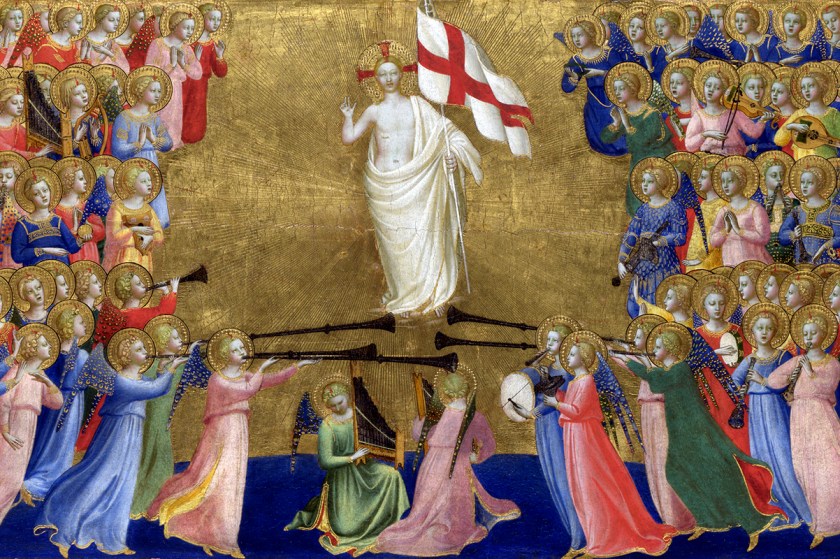
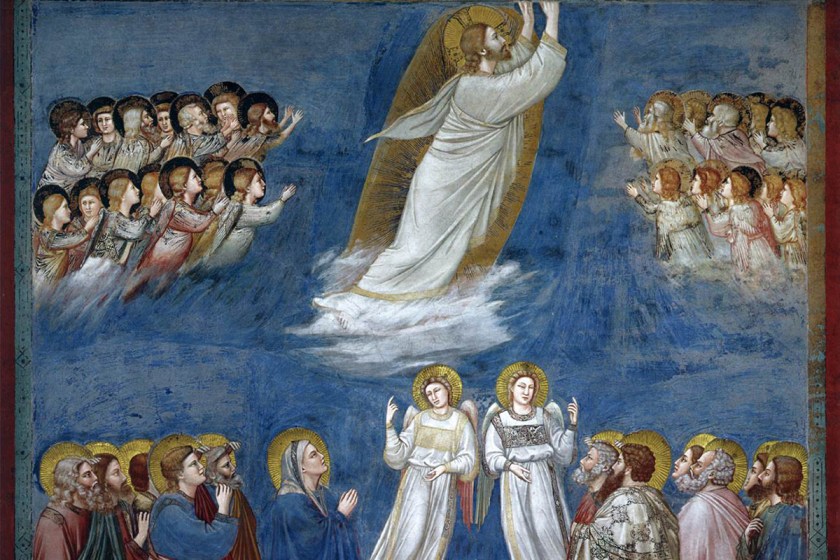
In the past, when I’ve thought about the Ascension, I’ve wondered, “What’s the big deal about Christ floating up into the clouds?”  I’ve felt that perhaps, the Ascension is slightly anti-climactic after the resurrection event. My imagination also has been stunted, since I can’t seem to picture the Ascension in any way that doesn’t seem ridiculous, whether flannel-graph-childish or Cape-Canaveral-Spaceship-launch. But this year, meditating on the Ascension has brought me great joy because this statement has been singing through my mind: The Ascension means that Christ is our King and is also our Brother. The Ascension is more than a miracle showing Jesus’ mastery over the physical world. It is Christ’s enthronement, when he is seated at the right hand of God as King and Priest. To be seated at God’s right hand is a frequent Biblical metaphor, especially noteworthy in Psalm 110, where a figure is foretold who unites the offices of King and Priest, with all things subjected under him.  Hence, right before his Ascension, Christ could declare “All authority in heaven and on earth has been given …


Rogation Prayer Bunting

Amanda had the idea for a prayer bunting to hang in your home, or around your garden, as a way to celebrate the Rogation days in your family.  The first page has a few prayers already included on the flags, and the remaining two pages have room to write your own prayers, and for children of non-writing age to draw their prayers.  Just another visible reminder of our responsibility to pray always for our neighbors, communities, and society at large. Cut the flags and fold them and secure with tape over some kind of string.  Kabob skewers work well to hold the flags in the ground.  We would love to see some of your Rogation buntings as well!  Tag us on Instagram @thehomelyhours. RogationFlags

What are the Rogation Days?

This upcoming Sunday is Rogation Sunday, followed by the Rogation Days on Monday, Tuesday, and Wednesday. The lore of these days includes “beating of the boys” and a mysterious pastry called “Rammalation Biscuits,” so research was particularly interesting. What are the Rogation Days and how did they begin? From the always helpful Anglican resource Full Homely Divinity: The Rogation Days, the Monday, Tuesday, and Wednesday before Ascension Day, originated in Vienne, France (not Vienna, Austria), in 470 after a series of natural disasters had caused much suffering among the people. Archbishop Mamertus proclaimed a fast and ordered that special litanies and prayers be said as the population processed around their fields, asking God’s protection and blessing on the crops that were just beginning to sprout. The Latin word rogare means “to ask”, thus these were “rogation” processions. In an agricultural society, closely connected with the soil and highly vulnerable to the uncertainties of nature, this was an idea that took root quickly, and the custom spread around Europe and over to Britain. The Sunday before the Rogation …

The Common and Best Things

While struggling against discontentment with the everydayness of life, it can be tempting to seek escape from the mundane. But, perhaps the way of joy is to come closer to the common– to become more attentive to the very things that seem endless. Perhaps faith in the God who chooses bread, wine, and water as his sacraments means a faith that insists upon meaning in the most common things. Sixteenth century Anglican clergyman and poet Thomas Traherne believed this: “I was guided by an implicit faith in God’s goodness: and therefore led to the study of the most obvious and common things. For thus I thought within myself: God being, as we generally believe, infinite in goodness, it is most consonant and agreeable with His nature, that the best things should be most common. For nothing is more natural to infinite goodness, than to make the best things most frequent; and only things worthless scarce. Then I began to enquire what things were most common: Air, Light, Heaven and Earth, Water, the Sun, Trees, Men and …

“Darkness Flees at the Death of Death”

For Death is about to learn the final lesson: That Life and Death are after all not peers. They are not of the same kind; they are not cut from the same mold; they are not two sides of the same coin. Death is of the mortal creation. Death reigns as King over the mortal world. But death, by definition has no place in immortality. Infinity, which can hold all things, has no room for finitude.

“Now All Things Have Been Filled with Light”

Alleluia! Christ is risen! We have compiled some quotations from the church fathers, for your reflection and joy this Easter. St. John of Damascus: “Now all things have been filled with light, both heaven and earth and those beneath the earth; so let all creation sing Christ’s rising, by which it is established.” St. John Chrysostom: “O Death, where is your sting? O Hell, where is your victory? Christ is risen, and you are overthrown. Christ is risen, and the demons are fallen. Christ is risen, and the angels rejoice. Christ is risen, and life reigns. Christ is risen, and not one dead remains in the grave. For Christ, being risen from the dead, is become the first fruits of those who have fallen asleep.” St. Augustine: “Our Life himself came down into this world and took away our death. He slew it with his own abounding life, and with thunder in his voice he called us from this world to return to him in heaven. From heaven he came down to us, entering first the Virgin’s …

Baking Bread for Maundy Thursday

On Holy Wednesday, we gathered with our young children to prepare for the rest of Holy Week, through baking bread that would be used for our communion service on Maundy Thursday and hearing a Godly Play lesson. The children listened to the account of the Twelve gathering with Jesus in the Upper Room. Then, we went to the church kitchen to bake bread. We used the recipe from Bethany at a Spoon Full of Yum that we posted yesterday. We ended up with these artfully formed, practically unmouthed (oh, toddlers) rolls of dough! Here is our bread before some of the older children processed to present it to our priest during the offertory. It was special for them to be able to participate so integrally in our Maundy Thursday service! Disclaimer to those who partook: All little hands were washed in the making of this bread and the oven was at 500 degrees.  

Bach’s Passion Cantatas: A Musician’s Perspective

As part of Lenten and Holy Week observances, many listen to Bach’s St. Matthew or St. John Passion cantatas. If you don’t own recordings, you can easily find them on Spotify or Youtube. Because of this tradition, we thought it might be interesting to get an insider’s perspective, a musician who has played both cantatas. Fiona Hughes is professional baroque violinist who plays in many early music ensembles, including the Handel and Haydn Society and the Washington Bach Consort. She is also the founder and co-director of Three Notch’d Road. Fiona attends All Saints Anglican Church in Charlottesville, VA. When and where have you played the St. Matthew and St. John Passions? As a violinist, I have performed Bach’s Passions 10-15 times because I specialize in early music of the baroque era.  I have performed the Passions in various locations on the East Coast: Calvary Episcopal Church in Pittsburgh, Oberlin College in Ohio, Staunton Music Festival in Virginia, National Presbyterian in Washington DC, and most recently (yesterday in fact) with the Handel + Haydn Society …

The Breastplate of St. Patrick

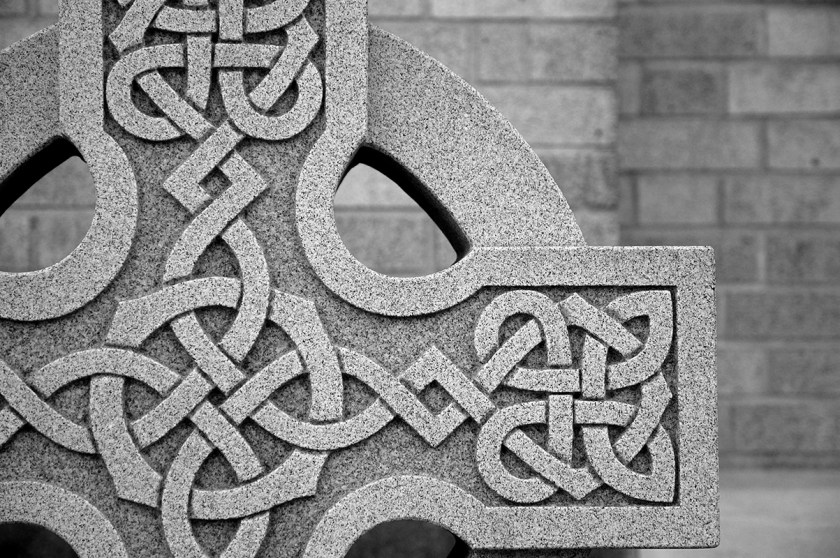
I look forward every year to St. Patrick’s Day and Trinity Sunday because of singing “The Lorica [or Breastplate] of St. Patrick.” It is a glorious expression of the cosmic realities of our Christian faith. Here is a beautiful arrangement by Melville Cook, sung by St. Peter’s Singers of Leeds: What is a Lorica? The original meaning of “Lorica” is armor or a breastplate. It developed, in the Christian monastic tradition, to mean a prayer of protection. These meanings merged in the reality that knights would often inscribe prayers upon their armor or pray these prayers before they went into battle. Are there other examples of loricas? Yes, there is the “Lorica of Gildas.” The Lorica, Rob tu mo bhoile, a Comdi cride, forms the basis for the hymn “Be Thou My Vision.” The Fursey Lorica is also particularly beautiful: The arms of God be around my shoulders The touch of the Holy Spirit upon my head, The sign of Christ’s cross upon my forehead, The sound of the Holy Spirit in my ears, The …

Prayer Beads for Kids

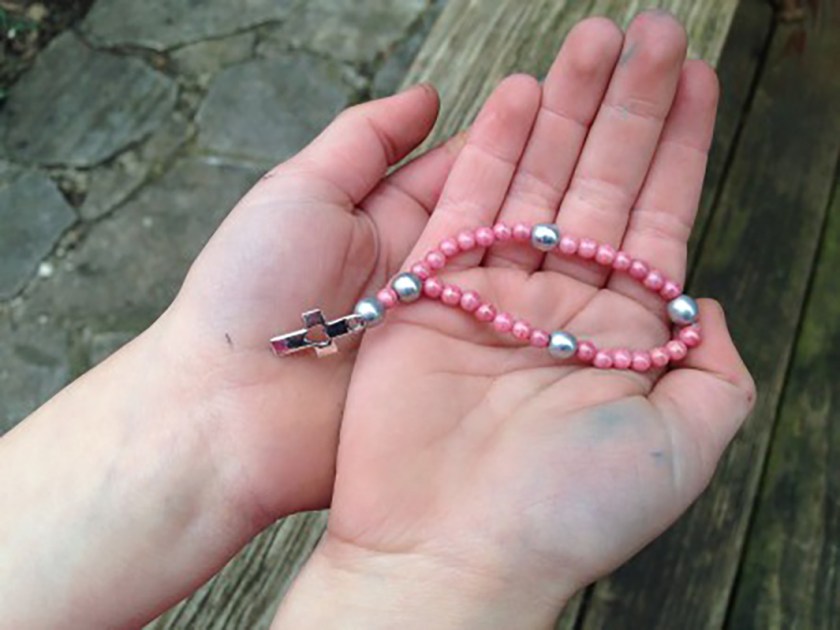
One of my goals this Lent is to spend more time in prayer.  My husband gifted me a beautiful set of Anglican prayer beads for Christmas, and the practice of using the beads and ages old prayers, in a rhythmic, defined manner, has made prayer more accessible to me.  And so I am much more inclined to spend time doing it! As I’ve been keeping them around on my desk areas for use, my charming and curious children have asked me what they are for, and so I decided to make them some of their own.  I was somewhat surprised that they were interested, but we ran with it, and came up with these simple circlets for their use. These can be made out of anything, and would be a fun Lenten family activity, or perhaps a surprise in their Easter basket?  Use what you have on hand; plastic pony beads in two colors on a piece of yarn would work just fine. The important thing is to place your beads in this form: For …